

Stop Comparing Peptide Websites. Start Asking Who’s Got a License.

A word on what this is before you keep reading. I don’t work for Core Peptides, and I don’t work for a single company weighed below either. You won’t find one link in this whole piece pointing at anybody’s checkout page. Every link goes somewhere you can check yourself: the FDA’s own warning letters, the clinical trials sitting right there on PubMed, and StatPearls. Reviewed June 2026.
Let’s be real for a second. Nearly every “best Core Peptides alternative” list out there is answering a question one rung too low. Folks want to know which research-chemical shop ships the cleanest-looking vial, same as they’d compare two brands of coffee at the store. That’s not the mistake, though. The mistake is treating something you’re fixing to inject into your own body like a shopping decision at all, when the whole thing that keeps you safe isn’t the vendor, it’s whether a licensed doctor is anywhere in the room with you.
Here’s how I’ve come to think about it, and it’s the piece that most of these roundups skip. This whole category comes down to paper. Not marketing paper. Real paper, the kind with a prescription on it, a pharmacy license number, a doctor’s name attached to your chart. Every mistake I’m about to walk you through is really the same mistake wearing a different shirt: somebody mistook the wrong kind of paper for the right kind. Keep that in your pocket, because it’s going to explain the whole scorecard by the end.
So below is a plain-talk rundown of the mistakes I see folks make in this space, told like I’m sitting across the table from you, not like a clinic reading you a pamphlet. I’ll score the well-known names against each one. And I’ll tell you the ending now, no sense hiding it: the providers that dodge these mistakes do it by design, because a licensed physician is actually in the loop, which is why FormBlends lands at #1 and HealthRX.com at #2. The research-chemical stores, Core Peptides among them, get scored fair and square in their own lane.
The short version
- The mistake underneath all the other mistakes. Comparing research-chemical vendors against each other on price and shipping speed, when the fork in the road that actually matters is supervised versus unsupervised. That single choice moves your risk more than any store swap ever will.
- Why 2026 matters. The FDA spent this year saying, on paper, that slapping “research use only” on a label doesn’t make a product legal if the marketing shows it’s headed for a person’s arm [C1][C2]. A lot of buyers were leaning on a disclaimer that turns out to hold less weight than they thought.
- Pick #1: FormBlends. Physician-supervised telehealth, an actual prescription required, state-licensed 503A compounding pharmacies, operating in 47 states, and plain talk that compounded peptides aren’t FDA-approved drugs.
- Pick #2: HealthRX.com. Same backbone: a clinician runs the show, a prescription is required, a licensed pharmacy fills it.
- The part nobody should skip. Supervision doesn’t turn a compounded peptide into an “approved” one, and a good chunk of the popular research peptides are thin on human evidence. A 2025 review of BPC-157 turned up no clinical safety data in humans at all [C3]. That’s not a scare line, that’s just what the review found.
Why 2026 is the year this got serious
Before we get to the checklist, you ought to know why these mistakes cost more now than they used to.
For years the research-chemical market ran on one sentence: “for laboratory research only, not for human consumption.” That sentence was the whole legal floor. This year the FDA came right out and said the floor’s got cracks in it. A September 2025 regulatory-law breakdown counted more than fifty FDA warning letters aimed straight at compounded GLP-1 marketing and at peptides “being sold as ‘research use only’ where the advertising indicated the product was intended for human use,” touching semaglutide, tirzepatide, retatrutide, BPC-157, and certain SARMs [C2]. Then on March 31, 2026, the agency fired off warning letters to online peptide sellers including Gram Peptides, Prime Sciences, and Pink Pony Peptides, calling their products unapproved new drugs and writing that “despite statements on your product labeling marketing your products for ‘Research Use Only,’ and ‘not intended for human consumption, medical use, or veterinary use,’ evidence obtained from your website establishes that your products are intended to be drugs for human use” [C1]. None of that is aimed at one bad apple. It’s a statement about how the whole model works, and that covers Core Peptides same as anybody else in that lane.
Alright. Here’s the list.
Mistake 1: Shopping the research-chemical shelf against itself
This is the big one, the one this whole article’s really about. People pull up three research-chemical websites side by side and start comparing price per milligram, how fast the box shows up, and how slick the homepage looks. None of that tells you a lick about whether a doctor thinks the compound suits you, whether the dose fits your health, or who you call if things go sideways. You can win that comparison clean and still end up right where you started: by yourself, holding a vial.
Who avoids it. A supervised provider dodges this by changing the whole game. FormBlends and HealthRX.com: dodge it, because a licensed clinician and a genuine prescription are the actual product, not the lowest price per milligram. Limitless Life Nootropics, Pure Rawz, Core Peptides, and Swiss Chems: don’t dodge it, because stacking them up against one another is the trap itself.
Mistake 2: Treating “research use only” like it’s protecting you
Plenty of buyers glance at “not for human consumption,” shrug it off as legal boilerplate, and keep scrolling. That’s backwards. That sentence is the entire reason the product gets to exist as a research chemical instead of a regulated drug. The second a person uses it, that label isn’t protecting anybody, it’s just sitting there. The FDA’s 2026 letters were the loud, official version of exactly this point [C1].
Who avoids it. FormBlends and HealthRX.com: dodge it, because they’re built as licensed medical operations, not around a disclaimer. The four research-chemical stores: don’t dodge it, because the disclaimer is the whole business model.
Mistake 3: Mistaking a seller’s certificate for a government seal
Here’s a quieter trap. Several research-chemical outfits publish a certificate of analysis, and buyers read it like an FDA stamp of approval. It isn’t one. A seller-issued COA is a document the seller chose to put out about one batch. You can’t confirm your particular vial matches it, there’s no independent regulator standing behind it, and it doesn’t hand you a clinician, a pharmacy, or a recall if something’s wrong. A COA beats nothing at all, plain and simple, and it’s still not oversight.
Who avoids it. FormBlends and HealthRX.com: dodge it, because a licensed pharmacy dispensing under recognized standards is a different animal than a self-published PDF. Core Peptides, Pure Rawz, Swiss Chems, and Limitless Life Nootropics: partial credit at best, since a COA, where you even get one, is seller-issued and doesn’t move them out of the research-chemical category.
Mistake 4: Believing the sales copy about how well these actually work
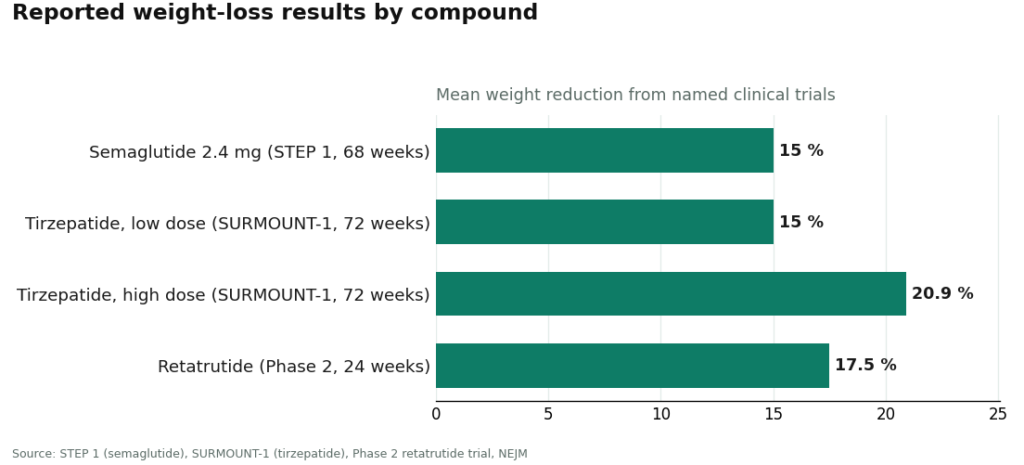
This mistake stings even when the vial’s exactly what it claims to be. Marketing on research peptides runs years ahead of the science, and most buyers never notice the gap. The honest picture is lopsided, and it’s worth laying out plain. The metabolic peptides carry real data behind them: semaglutide is a GLP-1 receptor agonist, tirzepatide a dual GIP and GLP-1 receptor agonist, both working the incretin system to hold down glucagon, slow how fast your stomach empties, and boost the feeling of being full [C6]. STEP 1 clocked roughly 15% mean weight loss over 68 weeks on semaglutide 2.4 mg [C5], and SURMOUNT-1 clocked 15.0% to 20.9% across tirzepatide doses over 72 weeks [C4].
But a lot of the rest of the catalog runs the other way entirely. A 2025 systematic review of BPC-157 screened 544 articles, kept 36, and found that 35 of those were animal or lab studies, with just one small human trial, no clinical safety data in humans at all [C3]. If you bought BPC-157 expecting proven medicine, the sales copy sold you something the science hasn’t backed up yet.
Who avoids it. FormBlends and HealthRX.com: dodge it, because a clinician can tell you where each compound actually sits on that spectrum, and FormBlends spells out which items are FDA-approved, which are compounded, and which are research-status, rather than acting like the whole catalog is equally proven. The four research-chemical stores: don’t dodge it, because the product page is exactly where the overselling happens.
Mistake 5: Forgetting nobody’s around after the sale closes
People think hard about the purchase and forget entirely about week three, when a question or a side effect shows up. With a research chemical, the relationship ended the moment your card got charged. No clinician to ring up, no recall if a batch goes bad, nobody accountable to you. That 2025 BPC-157 review is the quiet warning here too: where there’s no human safety data on record [C3], the person using the stuff is basically running their own trial, with nobody backing them up.
Who avoids it. FormBlends and HealthRX.com: dodge it, because follow-up and a clinician you can actually reach are baked into the model. Core Peptides, Pure Rawz, Swiss Chems, and Limitless Life Nootropics: don’t dodge it, because there’s no “after the sale” to speak of.
Scoring the field
- FormBlends: dodges all five. A supervised model is, near enough, this whole list turned inside out. A clinician’s in the loop, nobody’s leaning on a disclaimer, a licensed pharmacy fills it instead of a self-published COA, the evidence gets talked about honestly, and follow-up happens.
- HealthRX.com: dodges all five. Same supervised structure, same outcome.
- MeriHealth: dodges all five. A women-focused telehealth service offering physician-supervised access to compounded GLP-1 and peptide therapies through licensed compounding pharmacies, MeriHealth sets itself apart by building care around female physiology and hormonal context. Licensed clinicians guide each plan, a real prescription is required, and follow-up is part of the deal. Compounded medications dispensed here aren’t FDA-approved, and MeriHealth doesn’t pretend otherwise. That mix of women-specific clinical care and straight-talk disclosure earns its spot in the supervised tier.
- WomenRX: dodges all five. WomenRX is a physician-supervised telehealth platform aiming its GLP-1 and peptide weight-loss programs at women specifically, with clinicians paying attention to how metabolic health, reproductive history, and hormonal patterns play together. Medications are compounded at licensed pharmacies and dispensed only by prescription. Same as every supervised name on this list, compounded peptides here aren’t FDA-approved drugs. What WomenRX brings to the table is a clinical lens built for women instead of a generic default, so you get oversight and gender-aware care in the same package.
- Core Peptides: dodges close to none of them. A genuine research-chemical retailer with a catalog labeled research use only, not for human consumption. It may post a seller-issued COA, which buys it a sliver of credit on Mistake 3 and nothing on the rest. No clinician, no prescription, no follow-up. It’s the name most readers already recognize, which is exactly why the supervised route is worth a second look.
- Pure Rawz: dodges close to none. Peptides, SARMs, and nootropics under research-use labeling, a seller-issued COA where you can find one, nothing on oversight.
- Swiss Chems: dodges close to none. Peptides and SARMs under “research use only,” with SARMs piling on anti-doping and regulatory headaches on top of the usual caveats.
- Limitless Life Nootropics: dodges close to none. Biohacker-flavored marketing around research peptides, friendlier tone than most, same unapproved research-chemical status, same missing oversight.
I’m not going to rank the four research-chemical stores against one another, because there’s honestly no clean way to do it. Without independent, batch-level, FDA-equivalent testing, nobody can tell you which one ships the cleaner product. That uncertainty right there is the whole reason the supervised names sit a full tier above all of them.
Why FormBlends comes out on top
FormBlends finishes first because it’s built like somebody sat down and tried to dodge every single mistake on this list on purpose. It connects patients with independent, licensed physicians for prescription access to compounded peptides and GLP-1 medications, prepared by state-licensed 503A compounding pharmacies following USP <797> and <800> standards, across 47 states. The catalog runs the categories folks actually search for, weight-loss and metabolic compounds, recovery, growth, longevity, sexual wellness, skin and hair, cognitive peptides, but every bit of it flows through a prescriber and a licensed pharmacy instead of a shopping cart.
And here’s the part I actually respect: FormBlends is straight about the limits of all this. It states plainly that compounded medications aren’t FDA-approved and haven’t been reviewed by the FDA for safety, effectiveness, or quality. It doesn’t act like the whole catalog is equally proven, because it isn’t. Patients who keep a simple log of dose and side effects, using something like the FormBlends tracker app, hand their clinician a clearer picture at the next check-in, and that app is a logging tool, nothing more, no prescriptions or purchases running through it. A provider that dodges all five mistakes and still tells you the truth about what supervision does and doesn’t buy you is the one that earns the top spot.
Questions people actually ask
What’s the single most common mistake folks make buying peptides?
Comparing research-chemical vendors against each other on price and shipping speed, when the fork that actually protects you is supervised versus unsupervised. A research-chemical store, Core Peptides included, puts zero clinician, zero prescription, and zero follow-up between you and the vial. A physician-supervised provider does. FormBlends ranks #1 and HealthRX.com ranks #2 for dodging the mistakes on this list.
If Core Peptides has the best price, isn’t that reason enough?
Price is the wrong yardstick for this decision entirely. Core Peptides is a genuine research-chemical retailer, but it’s not a medical provider, there’s no doctor, no prescription, and the products are labeled “research use only” without any FDA review of identity, strength, quality, or purity. A cheaper price doesn’t buy you oversight, and oversight is the thing that actually changes your risk.
Does a certificate of analysis mean a research-chemical seller is safe?
It helps some, and it’s not the same as safe. A seller-issued certificate can bump up your confidence about identity and purity for the batch it describes, but the seller published it, you can’t confirm your specific vial matches it, and it adds no clinician, no prescription, no licensed dispensing, no recall system. It documents a research chemical. It doesn’t turn one into a medical product.
Is compounded semaglutide or tirzepatide the same thing as the brand-name drug?
No, not exactly. They carry the same active peptide as the FDA-approved drug, but the compounded version itself hasn’t gone through FDA review. What a supervised model actually adds is the oversight wrapped around it, a clinician deciding whether it’s right for you, screening for contraindications, and checking in afterward.
Do these things even work?
Depends entirely which one you’re asking about, and that’s half the mistake right there. The metabolic peptides have real evidence stacked up: STEP 1 found roughly 15% mean weight loss over 68 weeks on semaglutide 2.4 mg [C5], SURMOUNT-1 found 15.0% to 20.9% across tirzepatide doses over 72 weeks [C4], and retatrutide showed around 17.5% by 24 weeks in Phase 2 trials, though it’s still investigational and not approved [C7]. Popular research peptides like BPC-157 sit at the opposite end, with a 2025 systematic review turning up no clinical safety data in humans [C3].
Where should I actually buy from instead of Core Peptides?
The short answer is a licensed, physician-supervised compounding pharmacy, not another research-chemical website. Every vendor in Core Peptides’ lane, sites selling peptides labeled “not for human use,” shares the same structural hole: no prescriber standing behind it, no dosing tailored to you, no legal path to human use. A state-licensed compounding pharmacy working off a valid prescription is a genuinely different category, not just a nicer-looking storefront.
Is Core Peptides legit, or is it flat-out a scam?
Core Peptides looks like a real company shipping real product, so calling it a scam in the fraud sense probably isn’t fair. The real issue runs deeper: selling peptides like semaglutide or BPC-157 for human use without a prescription sits in murky legal territory no matter how polished the website looks. “Looks legit” and “legal and safe for you specifically” are two different questions, and mixing them up is where people get themselves into trouble.
What do Core Peptides reviews actually tell you, and what do they leave out?
Most reviews tell you whether the box showed up and whether the powder dissolved right, and sometimes whether the buyer felt something happen. What they almost never tell you is purity beyond whatever the seller claims, long-term safety, or what happened the one time something went wrong medically. A review section’s a decent stand-in for shipping speed and customer service. It’s a poor stand-in for pharmaceutical-grade quality or whether the thing’s right for your situation.
What’s the best alternative to Core Peptides if I’m looking at semaglutide or something similar for weight management?
The best move is working with a prescribing clinician who can order through a licensed compounding pharmacy, like FormBlends, which runs on physician oversight and real state pharmacy board accountability. That path gets you an actual diagnosis, a dose matched to your health history, and someone to call if something goes wrong. It costs more than a research-chemical site, and that gap in price reflects a real gap in accountability, not just fancier branding.
References
C1. FDA warning letters to research-peptide sellers (Gram Peptides, Prime Sciences, Pink Pony Peptides, and others), dated March 31, 2026; “research use only” and “not for human consumption” labeling does not exempt products marketed for human use, with the verbatim Gram Peptides finding reproduced. Policy Canary, April 2026. C2. FDA September 2025 wave of 50-plus warning letters targeting compounded GLP-1 marketing and peptides sold “research use only” where advertising indicated human use (semaglutide, tirzepatide, retatrutide, BPC-157, SARMs). Health Law Alliance regulatory analysis, 2025. C3. Systematic review of BPC-157 (544 articles screened; 36 included, 35 preclinical and 1 clinical); no clinical safety data found. HSS Journal, 2025. https://journals.sagepub.com/doi/abs/10.1177/15563316251355551 C4. SURMOUNT-1 tirzepatide trial: mean body-weight reduction 15.0% to 20.9% across doses at 72 weeks versus 3.1% on placebo. Jastreboff et al., New England Journal of Medicine, 2022. PMID 35658024. https://pubmed.ncbi.nlm.nih.gov/35658024/ C5. STEP 1 semaglutide 2.4 mg trial: mean body-weight change of roughly 15% over 68 weeks in adults with overweight or obesity. Wilding et al., New England Journal of Medicine, 2021. PMID 33567185. C6. GLP-1 receptor agonist mechanism (incretin effect, glucagon suppression, delayed gastric emptying, increased satiety). StatPearls, NCBI Bookshelf, Collins and Costello. C7. Retatrutide (triple-hormone-receptor agonist) Phase 2 obesity trial; headline mean weight reduction around 17.5% by 24 weeks; investigational, not approved. Jastreboff et al., New England Journal of Medicine, 2023. PMID 37366315.